Facebook

Twitter

Showing posts with label prednisone. Show all posts

Tuesday, April 26, 2016

SfMCR: An imperfect storm

Eating dinner while still doing the sitting exercise.
My painful experience in a double-wide wheelchair was traumatic, to say the least. When a physical therapist showed up in my room the next day to see if I was ready for my exercises, I insisted they find me a small wheelchair. They dug around trying to find a child-sized one, which they couldn't locate, but I really just wanted to make sure it wasn't a large one.

After the combined physical and occupational therapy session, I was wheeled back into my room  to proceed to the sitting portion of my training. As I explained in my last Scenes from My Coma Recovery, sitting as long as possible was an important part of my rehab. Sitting sounds like simple lounging--prolonged sitting is actually considered harmful for most people--but I had been horizontal for six weeks. Without support my body flopped over like a wet noodle.

I always made sure they put the leg rests back on the wheelchair after my sessions in the "gym" because it quickly became painful to sit without my feet being supported. The supports were removed to allow me to do the exercises, and they didn't always remember to replace them after I was finished.

Once I was back in my room, I realized they had forgotten again and pointed that out to the assistant physical therapist who had wheeled me to my room. He went back to the gym and retrieved them for me. I thanked him and he left.

It wasn't long before I realized that my feet didn't quite reach the footrests. They must've given me the footrests from a larger wheelchair, I reasoned. I pressed the call button. Once the nurse reached Angel, a pudgy, good-humored, physical therapist I liked, he came and adjusted the rests a bit. But my feet still didn't reach.

He tried again, but said, "They're on the shortest setting already."

"But my feet still don't rea," I said, running out of air at the end, as usual. "They fit before."

"I'm sorry," said Angel. "They can't be adjusted anymore."

"They must be the wrong ones."

Sigh. "I'll go look."

When Angel came back, my feet still didn't reach.

"There aren't any others in the gym," he told me.

I noticed a pair of supports in the area of the room where spare equipment was stored. But when he retrieved them, they actually turned out to be extra large.

I was starting to feel worked up, my trauma from the day before still fresh on my mind.  "What am I going to do?" I began crying. "It's going to hurt."

"I'm really sorry, but there's nothing I can do. Why don't I get you a pillow?"

I shook my head violently, remembering how the pillows the day before only made things worse. "It's going to hurt."

By this time, Joella was there on her regular visiting shift. She checked the settings herself. "They're on the shortest settings now," she confirmed.

"They fit before," I repeated. "Please try again."

Angel fiddled with the footrests again. This went around and around, until Joella got so exasperated that she threw her cell phone on the hard tile floor, breaking it.

About this time, you're thinking I was being unreasonable. And you would be right. But you have to remember that I was on a high dose of prednisone, which plays havoc with your emotions. Add that to my trauma the day before and the stress of my recovery.

I eventually relented and agreed to try a pillow. I really didn't want to be making such a fuss. But my legs soon started hurting because my left foot still didn't quite reach. I shifted my position. And shifted again. And yet again. The pillow fell off the rests.

I pressed the call button once more. A CNA eventually appeared. She put a thicker pillow under my feet, but that proved to be too thick. Now the left foot fit, but my right felt jammed. Still, I decided to give it a try. It wasn't long before my legs started to hurt again.

I had the idea stuck in my mind that the original rests were still hiding in the gym somewhere. Another search, another goose egg.

This time, a different physical therapist showed up. I liked him, too, and I was embarrassed to be putting up such a fuss.

"But it fit before."

"You were probably sat too far back in the chair." He adjusted my back pillow, which was a thin pillow brought to me from our home. It was quite comfortable. Indeed, I continued to use it with the wheelchair after I left the nursing home, and I'm sitting against it now. But because it wasn't designed for wheelchairs, it had a tendency to shift.

The new position was a bit better, yet my legs still didn't quite sit flat on the rests. But he helped shift my position in the seat (I was so weak that I could only help slightly).

Ah, problem solved.

The moral of the story? Being in a nursing home is stressful. Compounded with pain, trauma, and helplessness, with a heaping dose of a medicine that is notorious for messing with your emotions, it makes for a volatile situation.
My elbow is resting on the thin pillow from home.

Thursday, February 4, 2016

My fate is in my hands

Yes, that's my hand and my keychain Magic 8-Ball.
I have written about this before, but I think that my atheism has helped drive my recovery.

Sure, my stubbornness has something to do with it--don't tell me I can't walk!--but knowing there's no one out there who's going to make things better makes me do it for myself.

I realize that believers find praying to God comforting. And they keep waiting and waiting for God to pick up the message.

I guess he screens his calls.

A famous large study of heart patients showed that patients who knew they were being prayed for actually did worse than those who weren't prayed for.

But like people relying on Magic 8-Balls, believers keep shaking that ball, waiting for it to say something other than...

ANSWER HAZY TRY AGAIN

They've all heard the canard that God helps those who help themselves--I wonder why that is?--but they still wait for the great big genie in the sky to make it better for them.

CONCENTRATE AND TRY AGAIN

But since I don't believe there's anyone up there, I know I have to rely on myself. My recovery won't happen on it's own.

IT IS CERTAIN

And there's a comfort in knowing that I have my fate in my own hands. The faithful are always excusing life's misfortunes by saying God works in mysterious ways.

BETTER NOT TELL YOU NOW

Well,  I don't have some fickle deity deciding to give me yet another bout of Legionnaires' disease because he woke up on the wrong side of the cloud.

MY ANSWER IS NO

I slowly weaned off prednisone early last year , so I'm no longer as immune-suppressed as I was. (My methotrexate also has immunosuppressive properties, but it's not coincidental that I haven't had a bout of pneumonia since I went off prednisone in late January of 2015.)

IT IS CERTAIN

I'm continuing to exercise on the stationary bike six times a week and hike once a week, not to mention my physical therapy exercises. I keep escalating the difficulty of the hikes. Indeed, the hike this Monday at Rocky Peak Park was the hardest yet (post and Tumblr link are forthcoming).

When I was a toddler, I had a shoestring with some large beads. I would chew on the ends of the lace, so they were rather frayed. I couldn't get one of the beads on, and I was getting red in the face with frustration. My mother took it from me. She was about to string it on for me when I grabbed it back, and said, "Me do it!"

I'm still like that when I feel frustrated. But when I see myself climbing new heights, I can say,

"Me did it!"

Will I recover the rest of my physical abilities without recourse to a higher power?

OUTLOOK GOOD

Wednesday, January 27, 2016

No pain, no gain, no sustain

Doing a little mugging during a walk. We have our own exercise bike at home.
Skating was the first thing I gave up after my lungs became damaged when I was 11. I loved nothing more than to skate...and skate fast. And I would skate until it was time for me to come home.

The first time I tried to skate when I was supposedly recovered, after several weeks of battling what was diagnosed as pneumonia, I returned home after only a few minutes. I couldn't understand how I could be so exhausted already. I tried a few more times, but those attempts ended the same way. I didn't yet know that I my lungs had been permanently damage, so I thought I would eventually take it up again after I fully recovered.

The bike went next. I could barely pedal up the slightest of inclines, so I was walking the bike more than I was riding it.

I thought I would return to the bike one day too.

I was still sickly for years after that, and there's a lot we may never know about what was happening to me. I suspect there was still some continuing disease process involved.

But the exercising I've been forced to do for my coma and stroke recovery has shown me how much strength I could've maintained if only I hadn't completely given up my formerly active lifestyle.

I didn't appreciate the profound impact of inactivity.

After my lung damage was diagnosed, the physical therapist I was assigned by Children's Hospital gave me aerobic exercise program to build my endurance back. But the PT greatly overestimated my ability. I could barely make it through the warm-up exercises, and that reinforced the idea of my new weakness in my mind.

I think I can't. I think I can't.

Even though I'm much stronger now, I still have difficulty with that kind of fast, sustained, vigorous exercise. Perhaps it has to do with the nature of my lung damage, which was later worsened by my two Legionnaires' disease bouts and repeated pneumonias.

Thanks again, prednisone!

I've always known that I could improve my stamina by exercising, but I never realized how much until I was forced to do it.

Not being able to walk is a great motivator.

The home physical therapist I was assigned after I left the nursing home used to take me for walks around our street. I liked Alan a lot more than I did walking along the suburban street. He advised me and Keith to find somewhere to walk. That was the best rehab advice he could've given me. I never would've built the endurance I now have by walking in our neighborhood. It's way too boring.

We started walking in the Sepulveda Basin Wildlife Reserve, with its abundance of Pacific Flyway birds, and branched out to various gardens. My attitude changed, as I began to push myself to walk ever farther.

Though I was pushing myself because I knew it would help my recovery, I never would've gotten as far as I have if weren't also enjoying myself.

Spinning is less fun, but we make the time pass by playing lectures from the Teaching Company. I love learning. Instead of concentrating on how tired I feel, I focus on the absorbing the information. When we can't watch a lecture, the time passes slowly and it begins to feel like a slog.

Hopefully, most people won't need Legionnairesacise to motivate them. But I think my experience holds some lessons for the people who haven't been through the kind of medical traumas I have.

It's not that exercising is too hard; it's just that you're weaker than you think. I can't emphasize enough how weak inactivity can make you. According to research, it only takes a few weeks for muscle atrophy to begin.

Make the exercise fun. Don't pick an exercise routine just because it's trendy or simply because you think it would be good for you. If it feels like torture, you'll eventually quit. If I had been assigned the exercise program I have now--fun, gradually advancing, and sustainable--I would've been much more likely to actually have stuck with it.

In short, do what I do now, not what I did!

Thursday, January 14, 2016

Fear is not magically delicious

Some of the difficult terrain I navigated on my first hike of 2016.
For the past week, I've been less unstable than usual. No, not my personality, it was my walking. I'll leave it to others to judge my emotional stability.

As some point, my exercising and increasingly strenuous rehab walks/hikes became more about retraining my brain than merely strengthening my muscles. I was originally told that most of my leg weakness was due to inactivity during my six-week coma. But I eventually reached a level where I could walk longer distances and for far longer than I could before my coma. I realized that the stroke-related weakness in my right leg, which seems slight when tested by my neurologist, has a much more profound effect on my walking than we recognized.

Wobbling from stroke-caused vertigo has a major effect as well. My balance exercises have helped tremendously in that regard, mostly by keeping me from falling on my face. But some of my exercises are directly aimed at reorienting my brain, encouraging it to get it's little synapses in gear and get on with the business of rewiring around its damaged areas.

Thank you, evolution.

Though I've said that I had nothing to do with the early days of my recovery--evolution again--I can own my later milestones. That took hard work. And my recovery is still a work in progress.

Yesterday, I had a follow-up appointment with my rheumatologist. My labs are still good, and she told me that after my next round of tests in three months, I don't need to see her if they remain that way. But the conversation soon turned to a few nagging concerns I've had.

Unfortunately, she confirmed a suspicion I've had for a while. My dermatomyositis (DM) is not in remission, after all. It's simply being well controlled. If I had been in remission, she would've taken me off my meds. At least I was finally able to get off the prednisone.

So long, and thanks for the brittle bones and nearly fatal immunosuppression.

The good news is she said that the fact that I haven't gone into remission doesn't mean I might have an underlying cancer triggering my DM. That's been a worry since my DM was diagnosed. That's a possibility I uncovered when I first discovered that I matched a list of symptoms of DM.

I'd crow about the fact that I diagnosed myself, except it hardly feels like a triumph that I have this serious rare autoimmune disease.

I haven't looked it up again because I quit Googling the condition cold turkey. It always depressed me because there are some deeply scary aspect to it. The foremost of which is my increased cancer risk.

She recommended that I do what I can, but forget about the things that I can't control. Well, I have been doing everything I can, exercising and getting cancer tests. But I have a hard time letting go of the known unknowns.

I told her that I don't believe there's a higher power making things come out alright for me. I need that sense of control, even if it's not real. But I'm not about to believe in a great big genie in the sky to give me that comfort.

But what can serve as a rabbit's foot for someone who doesn't believe in fate or lucky charms?

Friday, December 11, 2015

Zebraitis


In medical school doctors are taught, "When you hear hoofbeats, think of horses not zebras." It means that you should first consider more common diagnoses when confronted with symptoms. That makes sense...unless they're actually dealing with a zebra. Sometimes when doctors see zebras they only hear horses.

I've confronted this phenomenon repeatedly, as well as another common issue, the fad diagnosis. My two-year "walking pneumonia" when I was in my early teens was misdiagnosed as anorexia, which was first becoming widely publicized. I was still in the normal weight range, albeit near the bottom of the percentile. When the pediatrician said that, my mother told the pediatrician that I ate fine, though I had always had a small appetite. I'm actually notorious for my sweet tooth, yet I have a metabolism that people would sell their souls for (if souls actually existed). But the doctor couldn't figure out the cause of my persistent pneumonia, so he trotted out anorexia as the diagnosis.

It was allergies for a while until that too was ruled out. I was eventually referred to the pulmonary department. After a lung biopsy, they discovered that my lungs had been scarred by the mysterious virus that struck me when I was 11. Yes, my health has been bad for that long.

Years later, I found to my horror that I matched almost all of a long list of potential symptoms of dermatomyositis (DM) down to the last detail--included the disgusting photos of the characteristic Gottron's papules. Yet the dermatologist I saw laughed at the suggestion that I might have DM. He instead gave me a laundry list of skin disease diagnoses. Each area of rash had a different one. I forgot to ask him why I would suddenly develop these separate condition all over my body at the same time.

My muscles continued to weaken, and I was referred to a rheumatologist. She told me I was smart for identifying DM as a likely cause of my constellation of symptoms. But she thought DM was the second most likely diagnosis, behind the far more common psoriatic arthritis. She said if I had to have one, she preferred it to be psoriatic arthritis. After all my research into DM, I knew why. But when I returned home and looked up psoriatic arthritis, my heart sank. It didn't really fit my symptoms at all. The blood tests she ordered showed that I almost certainly had DM.

I was sent back to the laughing dermatologist for a skin biopsy to confirm the diagnosis. The dermatologist looked at my hands and said, "Now it looks like classic Gottron's papules." Actually, the rash had improved quite a bit by this time due to my treatment. He was obviously weaselling out of his cavalier dismissal of the possibility that I might be have dermatomyositis.

When I came down with Legionnaires' disease--thanks to the increased prednisone dose prescribed by that same dermatologist--and I suffered a series of strokes on both sides of my brain, which caused me to fall into deep coma, my doctors played the odds and decided I was a hopeless basket case. This is a related phenomenon to zebraitis. Most people in my situation never wake up, and if they do, they're left irreparably brain damaged. No need to listen to the reports of their loved ones of improving awareness. They all say that, doctors tell themselves. Just continue jotting down "poor prognosis" and move on to the next patient.

The problem with playing the odds with patients is that some will defy expectation or turn out to be a zebra, after all. Well, have a zebra, which is common enough that zebra is also a term for those unlikely diagnoses nonetheless suffered by a small minority of patients, like DM. But who's to tell which is which if you don't look?

I really wanted to be told I didn't have DM, yet a voice in my head told me that there were too many similarities with my symptoms to be a coincidence. That's why I kept bringing up the possibility to different doctors. And unfortunately, it turned out that I did have a zebra after all. My creatine kinase test--the one that diagnosed my DM--tested in the normal range when I first went to my primary care physician. I guess it was too soon. If the dermatologist had recognized my "classic Gottron's papules," treatment would've been started before the muscle damage had progressed. Or, if I had continued being tested, the muscle damage wouldn't have become so severe that I think I'm still suffering from it.

And, yes, it was most likely that I wouldn't recover from the coma. But because they were convinced that I wouldn't, they refused me therapy that could've hastened my awakening and reduced my recovery time. Every time I was moved or stimulated--for the MRI, GI tube insertion, or the move to my first nursing home--my awareness improved.

This is why I'm so eager for the development of bedside covert awareness detection using EEGs. There's no cure for zebraitis, but if it's cheap enough, doctor will have no excuse not to test the comatose. At the very least, they would be able to tell the patient's loved ones whether they're really aware or not.

When doctors play the odds sometimes it's the patients who lose.

Thursday, October 22, 2015

Coma chameleons

Now that I'm a contributing writer for The Secular Spectrum, I have a new outlet for my skeptical and humanist writing. Therefore, I feel free to write more directly about my recovery again in Coma Chameleon again. This blog is subtitled, My Recovery Chronicles, after all. This post, however, is also a continuation of some of my recent subject matter.Yes, that's right, my fellow coma victim and experiencer, Eben Alexander.

A few months ago, I finally received my hospital records from my 6-week coma in 2013, after being mistakenly given the records from my two-week 2014 hospitalization. Both were due to Legionnaires' disease, caused by immunosuppression. Thanks, prednisone.

The 2447 pages of the PDF (I received it on CD) is a treasure trove of details, sandwiched between mountains of repetitive information. I don't have the space to go into all the information, and I've only skimmed through parts of it. But I did learn one juicy tidbit. I knew that my lungs and kidneys were failing, but apparently my liver wanted to get into the act, as well. When I mentioned this, Keith joked that my spleen was doing fine, as was my appendix. Everything else was going south. My impression is that the liver problems weren't as severe as the other organ failures, a speculation my neurologist later confirmed. Otherwise, I would've been given a Charlson Comorbity Scale of 3 instead of 2. Think of what it would've done for the miracle-believers if I had managed to survive a score the maximum of six out of the twenty-two frequently fatal conditions that make up the scale.

In Proof of Heaven, Eben Alexander actually implies that the very rarity of E.coli meningitis in an adult is evidence that God chose him as His Special Messenger. After all, as a neurosurgeon, he was the perfect emissary to the disbelieving medical and scientific community. Yeah, right. Wouldn't neuroscientist Sam Harris have been even better? I suppose his argument is that God chose a rare condition as a sign that this was an act of God. Isn't he special? According the famous Esquire expose, Alexander has a reputation of arrogance. And he hides it so well.

At any rate, he seems convinced that the severity of his illness is another sign of God's hand. But as someone who was at least as close to death, you'll have to forgive me for not being impressed. My doctors were every bit as convinced that my death was imminent. I'll take one life-threatening bacterial infection--in my case, Legionnaires' disease--and raise him multiple strokes on both sides of my brain, severe sepsis, lung, kidney, and liver failure, as well as another potentially fatal bacterial infection, listeriosis. And compared to his measly seven days of coma, I was comatose for six weeks.

Take that, Eben Alexander, messiah to the scientific world.


Thursday, June 11, 2015

The Three Faces of Steph

My room in Skilled Nursing, where I was immediately whisked after my trach was removed, was freezing! Note how thin my hair had already gotten. This photo was soon before I left the nursing home.

Google's new photo-storing service employs facial recognition algorithms to lump photos of people together automatically. It's a work in progress. Indeed, like something out of science fiction, it thinks I'm three people.

The first Stephanie consists of my BC photos (Before Coma). The second Stephanie is comprised of my coma and nursing home pics. The final me is the current one; all of those pictures were taken after I came back from the nursing home.

Now, you might think that it's only gauging this based on my hair, since it went from long to braided to short. But perhaps Google Photos is onto something deeper.

At Donnafugata Castle in Sicily, two individuals with full manes.
Stephanie One had only recently been diagnosed with dermatomyositis. Though her shoulders were still weak from the DM proximal muscle damage, she was reluctant to cut her long, thick, curly hair short, even though it was so hard to wash and style, because it looked really nice and she got many compliments on it. Though the muscle damage in her hips, buttocks, and legs had improved considerably, she was pleased that her dermatologist put her on a significantly increased dose of prednisone, since the higher dose was clearly making her stronger, and she was afraid that she was still too weak to walk through the ruins of Sicily that beckoned to her. Even so, when Keith and Stephanie arrived in Sicily, her legs kept collapsing as she attempted to board the steep steps on tourist buses and the Mt. Etna funicular. She had also lost so much weight during her illness that she needed the prednisone to help her regain the weight she had lost from her already skinny frame. She had a license to make Sicily an all-you-can-eat buffet!

But the strong prednisone dose weakened Stephanie One's immune system so seriously that she caught Legionnaires' disease and listeria while in Sicily. The gastro-intestinal symptoms of the listeriosis presented themselves immediately and are best left to the imagination. But the Legionnaires' disease triggered a severe case of sepsis, which dropped her blood pressure so low that she experience a series of strokes on both sides of her brain, causing her to fall into a six-week coma. Thus, she morphed into Stephanie 2.0, who came about as close to dying as you can get without actually "passing over," as believers like to say. She lost further weight on the liquid diet being pumped into her system. When she awoke, it was many weeks before she was allowed to eat solid food again. Her tangle-prone hair was repeatedly braided and rebraided during this period to keep it looking neat. Brushing is out of the question when you can barely use your arms or even lift your head.

When Stephanie Clone Three got home from the nursing home, she was forced to cut her now-scraggly hair short because she had lost so much of it while she was still Stephanie, the Sequel, due to all the detangling and rebraiding, plus weakened hair from the respiratory distress suffered during the coma.

Keith put her on a high-calorie diet because she was starting to look like a Holocaust victim. That worked all too well, as the notorious weight-gain side-effect of prednisone finally kicked in. Her normally thin, angular face rounded and her stomach began protruding--yet more prednisone side effects, aided by the weight gain. But her hair regained its naturally unnatural thickness. During this time, her nonfiction writing about her recovery began to be accepted by major publications.


Who will Stephanie Mark Four be? Well, the difference may be too subtle for Google Photos to detect, but finally free of the curse of prednisone, her weight edges ever downward as her face continues to shed the round "moon face" caused by the corticosteroid. Ditto her "pregnant belly," which birthed no joy. But those had already shrunk considerably, anyway. Stephanie Three is finally starting to resemble Stephanie Prime--the "normal" one, relatively speaking, before even the DM.

Stephanie Three is expecting her feature article to appear any day now in Skeptical Inquirer. She's also finished her latest essay for the humanist market, "Sympathy for the Devil-Believers," and she's about to send it out. Her essay, "Without a Prayer of a Chance," is tentatively scheduled for the October/November issue of Free Inquiry. So, even though Stephanie Clone Four might not look that different from her previous iteration, by the time she appears, the story of all four Stephanies will be finally out. And then there's the new essay about her DM, not to mention the memoir she's now preparing to write....

Wednesday, May 6, 2015

Me do it!


When I was a toddler, I had one of those laces with plastic beads that were probably choking hazards, since this was back in the Paleolithic Era. The end had become frayed, probably because I had chewed on it. I couldn't get the bead on and got so frustrated that I was red in the face. My mother attempted to help, but I held the lace tight and said, "Me do it!" Eventually, after much jabbing, I succeeded.

That personality trait has served me well during my recovery. But the opposite tendency often pulls many of us into a negative feedback loop.

Learning why you have a problem, whether it's physical or mental, can be freeing. Certainly, when I was diagnosed with dermatomyositis, that knowledge was crucial. Before the advent of prednisone, DM was often fatal. The treatment I received after the diagnosis arrested my muscle damage and allowed my skin and muscles to begin the healing process.

My ADHD, on the other hand, is a more complicated issue. I've known since childhood that I had a severe case of ADHD. And, I was re-diagnosed in adulthood. Though that knowledge has helped me to work toward mitigating some of the unfortunate tendencies brought about by ADHD, I've too often let it be an excuse that instead held me back from achieving as much as I could. I can't help it because... That knowledge can make you feel like you're fighting against overwhelming odds. This is not just my foible; I've seen this phenomenon in many other people. It's a universal human weakness.

But I think instead of looking at these very real circumstances as excuses, people (myself included) need to start seeing them as the enemy. "How dare you tell me that I can't_____(fill in the blank). I'll show you!"

I never gave walking too much thought until the ability was taken away from me. The stubborn, persistent toddler in me wasn't about to let my body tell me I couldn't do something I've done since I was that age. Me do it!

There are less dramatic ways to defy your body and do what it's telling you is impossible. Yeah, maybe you can't ride on a stationary bike (which is what I use) for an hour. But you can do it for a minute. If you increase that by a minute a week, in sixty weeks you'll be riding for an hour.

I'm starting to sound a bit like a self-help guru. Actually, I think self-help should be just that. And you don't have to pay $500 for a seminar or a video series for that. That's not self-help; it's just surrendering yourself to a huckster who is helping his or her self to your hard-earned money. No, you need to literally help yourself. And all it requires is that you tell your personal challenges, "Me do it!"

Friday, April 3, 2015

Weighty matters


All my life I've been skinny. I'm one of those people everyone hates, with a great metabolism. I had a major sweet tooth, but I never had to worry about eating decadent desserts. Before my childhood lung damage was diagnosed, a pediatrician diagnosed my problem as anorexia. Never mind that it didn't fit my symptoms; it was the new, trendy diagnosis. I wasn't actually that skinny. My mother told him that I ate fine and I had always been that way, but he didn't believe her. Many years later, Keith used to tease people at his work by telling them that I could eat anything I wanted and still lose weight. Indeed, one time I became dangerously skinny just because I had increased my activity slightly by using our Wii.

But prednisone changed that.

Let's be clear, I'm hardly obese now. I weigh 113, with a BMI of 22.1--right smack in the middleof what's considered normal for someone who is five-foot tall. But I have extremely fine bones, and the BMI scale always overestimated what was normal for me. My usual average weight has been 95 pounds--plus or minus 5 pounds--my entire life. That was the weight my body naturally fell into without any effort. If I gained a little weight--and every pound looked like 5 on my tiny frame--all I had to do was trim a few extra calories and the weight would melt off, without any exercise.

When my dermatomyositis was first diagnosed, I thought I had inexplicably gained weight. I was 105 pounds, and I hadn't been eating any extra calories. I usually only gained weight when I had eaten many extra calories over a long period. If I had been more active, I probably wouldn't have gained any at all. After I started on the prednisone, I reduced my caloric intake to avoid gaining even more weight. But, instead of gaining weight, I started peeing my brains out and lost all that extra weight and then some. The extra weight was actually water retained by my muscles, which were inflamed by the DM, which was damaging them. I actually weighed about 86 pounds without all that swelling. My illness had actually made me lose 10 pounds. Suddenly, I was anxious about being too skinny.

But as the prednisone began to arrest my muscle damage, we started making plans for our trip to Sicily again. Keith almost cancelled the trip after the diagnosis. When we arrived in Sicily, I had a license to eat as many cannoli as I wanted. I was a kid in a pastry store.

Of course, after we returned from Sicily, I soon fell into a deep coma for six weeks. I was still skinny, even after all those cannoli, and I lost even more on the "liquid diet" being pumped into me during the coma. Even worse, I was put on a low-calorie, low-protein diet when my kidneys were failing. But the food mix wasn't changed back after my kidneys began functioning again. And after I awoke, they kept giving it to me, even when a doctor tried to fix the mistake. Eventually, my "food" order was changed, but the damage was done. I sank down to 83 pounds. To make matters worse, the nursing home wouldn't let me eat real food for several weeks due to my trach, and the liquid diet was giving me terrible diarrhea. I was starting to look like a Holocaust victim.

Before the trip--even though I was already too skinny--I discovered to my shock that I couldn't fit into most of my pants because my stomach was getting bigger from the notorious prednisone pregnant belly. Prednisone redistributes fat from your lower extremities to your waist and breasts. It also causes the charmingly named buffalo hump at the back of the neck. I've got that, too, along with the not-so-whimsically named moon face. My moon face is somewhat disguised because I have a thin, angular face, but it's definitely there. It was much worse last year.


Fortunately, they've all gone down quite a bit since I finally went off prednisone early this year. These unsightly side effects should eventually disappear altogether.

When I got back home from the nursing home, Keith put me on a high calorie diet, and I started gaining weight. I finally stopped the regimen when I realized I had overshot the mark and had gained too much weight. My repeated pneumonia's didn't help matters because every time I got sick again, the doctors raised my prednisone dose. The second bout of Legionnaires' disease was the worst. I was put on a high dose, which lasted for a month.

Now that I'm off the prednisone, I've been losing about a pound a month. I haven't been able to diet strenuously because I'm still trying to keep a healthy, balanced diet, but I have mostly cut out my beloved desserts. I've developed quite a taste for fruit, though. Fruit is my new form of sweets. And I still have that wonderful metabolism. Plus, I'm exercising a lot more than I did before my coma. The weight will continue to drop, and eventually I'll be back to 95 pound...give or take five pounds.


Friday, February 6, 2015

I won the lottery, but what I got was no prize


This is the blog I posted on Friends of the Mountain Dulcimer after my diagnosis of dermatomyositis was confirmed:
For someone who is not afraid to kvetch—hey, my people invented the word—it's kind of strange that I haven't let on about my recent health problems until now. Oh, I complained a bit about how wrapping all those Christmas gifts was killing my arms, but that was before I knew that there was something going on beyond my usual out-of-shape, pencil-armed weakness. I suppose a good way to tell if something is actually serious is if I'm too afraid to kvetch about it. And now that I'm well on the road to recovery, the fact that I'm ready to kvetch again could be taken as a good sign (for at least as long as you could stand it).

Dermatomyositis (DM) is a rare, but treatable, autoimmune disorder. Here's some info: http://mda.org/disease/dermatomyositis/overview and http://en.wikipedia.org/wiki/Dermatomyositis. Though I only received the definitive diagnosis on March 5, I first came across DM while consulting Dr. Google. I really didn't expect to find anything, let alone anything serious. I had already spent too much time fruitlessly looking for a match to the weird rashes I'd been suffering from. This time, on a whim, I added muscle weakness, pain, and the most severely affected skin areas (hands, elbows, and knees) as keywords. I quickly hit upon dermatomyositis. What I found left me deeply shaken. The distinctive DM rash called Gottron's papules matched mine in every detail of appearance and distribution, including the areas I had left out of the search terms. And I didn't even know that the painful cracking under the creases of my finger joints was called mechanic's hands until I saw it listed as a potential symptom. It was if a med student had been given an assignment to come up with an imaginary case-study and gone way overboard. But what scared me most was how the disease's most common course, rashes followed by weakness in the the muscles nearest the trunk, fit what was happening to me. Though the weakness in my already feeble arms was most obvious, I was also finding it increasingly difficult, not to mention painful, to stand up from a squatting position. Still, I consoled myself that DM was an extremely rare condition. I had never experienced any rashes quite like these before, but I had suffered from chemical- and abrasion-sensitive skin my entire adult life. Nonetheless, I knew I wouldn't rest easy until I could be sure that I didn't have DM, and I scheduled an appointment with my primary care physician.
With nerves added to my ADHD, I knew I would wind up leaving out important details, so I wrote a narrative account of the progression of my symptoms. At the very end I mentioned dermatomyositis, but I made it clear that I realized it was rare and I only wanted to rule it out as a possibility. My arms were already weak enough that I had to rest them frequently as I typed, yet when the doctor tested my muscle strength and range of movement my impairment was hard to tell from ordinary strain. Though he didn't order all of the tests I had read about it, he did test my creatine kinase level, a measure of muscle damage that is usually highly elevated in cases of DM. But, as it turned out, it was a little too soon for the disease process to show up.
My next stop, naturally, was a dermatologist. Unfortunately, none of my doctors were able to see my rashes at their worst because intensive treatment with over-the-counter cortisone products had been slowly improving them. The rash on my hands, however, was still quite evident. My fingertips and knuckles were red polka dots traced by lines that ran along the bony ridges of my hands like a connect-the-dots picture. I couldn't get out of my mind how closely it resembled the unique pattern of Gottron's sign, a hallmark of DM. But when the dermatologist got to the part of my narrative about DM, he was amused. “So you think you have dermatomyositis?” he said with a grin. He then proceeded to rattle off a handful of forms of dermatitis/eczema—each area seemed to have its own variety—and gave me some prescriptions for clinical-strength topical cortisone.
But as my rashes began to heal, my muscle problems continued to worsen. At this point I hadn't stopped playing the dulcimer, though the sessions were getting shorter and spottier. I found it difficult to keep my arms suspended over the fretboard, so even my noter hand would drop like a dead weight every few measures. It was getting harder for me to deny that there was something seriously wrong with me, but I did my best anyway. In the past I had suffered lower back strains that had refused to heal due to slight reinjuries. Wasn't that more likely than a rare disorder I found on the internet? So I decided to stop playing for a few days and to eliminate every possible source of strain to give my arms and shoulders a chance to heal. The days stretched on as the simplest tasks became a struggle, but it was also the beginning of the end. I emailed my PCP to tell him of my continuing muscle problems, and in response he gave me a referral to a rheumatologist.
I liked Dr. Bharadwaj from the start. It certainly didn't hurt that she told me I was smart for seeing that dermatomyositis was a potential diagnosis. Indeed, she considered it to be the second most likely behind psoriatic arthritis. The good news, she told me, was that both conditions were treatable, though if I had to have one it was better to have psoriatic arthritis. I was pretty sure I knew what she meant, and I'll get to that in a bit. The tests she ordered (I lost count at eight blood vials) soon tipped the scales toward DM, however. In a little over a month my creatine kinase level shot up from 175 (just outside the standard range) to 1075. Dr. Bharadwaj advised me to schedule a skin biopsy as soon as possible. Though it was better to hold off on treatment until after the biopsy to avoid affecting the results, she said if I felt I really needed it I could start on it sooner. I had been extremely leery of prednisone, but by this time my symptoms were worsening daily and I was ready to start popping it like candy. I was, therefore, dismayed when the earliest appointment I could get for the in-office biopsy was more than a month away. I sent an email to Dr. Bharadwaj to tell her about the delay, and I received a call from the dermatologist's office later that day. My new appointment was in two days. I told you I liked her.
When I saw the dermatologist for the biopsy, he examined the rash on my hands and remarked that if anything it looked even redder than before (actually, it was a lot better). Now, suddenly, it looked like “classic Gottron's papules” to him. None of that really matters though. What matters is that I filled my prescription for prednisone afterward, and from my first dose I started to feel better. A week later my creatine kinase level was down to 203 and it's now 109. Though I'm not yet back to my normal level of weakness, I am making steady progress. And I'm ready to start playing again.
Okay, so what about those aspect of DM that make it the less desirable autoimmune disease? Well, for one thing, there are the other systems that can become involved. Like my other early DM symptoms, it was easy to explain away my increasingly severe bouts of hoarseness because it was a symptom I had suffered from for so long in milder form, in this case due to allergies. Indeed, even when I learned about DM I found excuses to keep it off my already wide symptom checklist. But when I started to develop swallowing difficulties as well, the connection became impossible to deny.
To me, however, the scariest associated condition by far would have to be cancer. The relationship isn't well understood, but within the first two or three years after diagnosis there is a significantly increased risk that a malignancy will be found. After that the risk returns to near baseline. Fortunately, I've come up clean so far, but for the next few years this is going to be a sword of Damocles over my head.
I'm afraid that's a rather ominous note to end on. While I can't offer the kind of cheeky comic relief that Phil so memorably provided [Phil Chestnut is a member of Friends of the Mountain Dulcimer who had recently written about his hospital-gowned mooning as he paraded his backside down a hospital corridor]. I can at least leave you with a humorous coda. With the diagnosis of dermatomyositis all but certain, I bookended my appointment with Dr. Bharadwaj with a couple of cancer screenings. First up was an abdominal ultrasound. I had been assured that there was plenty of time between my appointments, but as the wait stretched on anxiety began to fill every crevice of my being not already occupied by the 32 ounces of water I had been instructed to guzzle an hour before the test. When I was finally led to the examining table, the sonographer asked why I was getting the scan. As she slimed my water-logged belly, I described the rare disease I found on the internet which was about to be confirmed as an even rarer case of googlitis that was real. And as I did so, she was quietly freaking out. Was it possible that the rashes on her body could be that too? After a few nervous questions she confessed the reason for her concern. I assured her that dermatomyositis was quite rare and she was unlikely to have it. Though I advised her to see a dermatologist, I added that I had a history of reacting to skin care products I had been using for years and she might want to try changing hers. That was the first thing I tried when I started breaking out with all those strange rashes.

Wednesday, January 21, 2015

A double-edged sword

Today is P-Day: The day I took my last dose of prednisone. It feels like we should be throwing a party.

Steroid medications are a classic double-edged sword; the cure is often worse than the disease. That's not quite the case for dermatomyositis, since before the advent of prednisone the disease was often fatal. Still, my treatment has come at a high price, and I'm not talking about the cost of the medication, which is dirt cheap because it's been out of patent for so long.

The worst things prednisone did to me, hand's-down, were the multiple strokes on both sides of my brain and the six-week coma the strokes caused. The immunosuppression triggered by prednisone weakened my immune system just as we were preparing for our trip to Sicily.When my dermatologist put me on a stronger dose, and my muscles started to strengthen, prednisone seemed like a godsend. Keith almost canceled our trip after my diagnosis because he feared that I would be too weak. He wasn't far wrong.

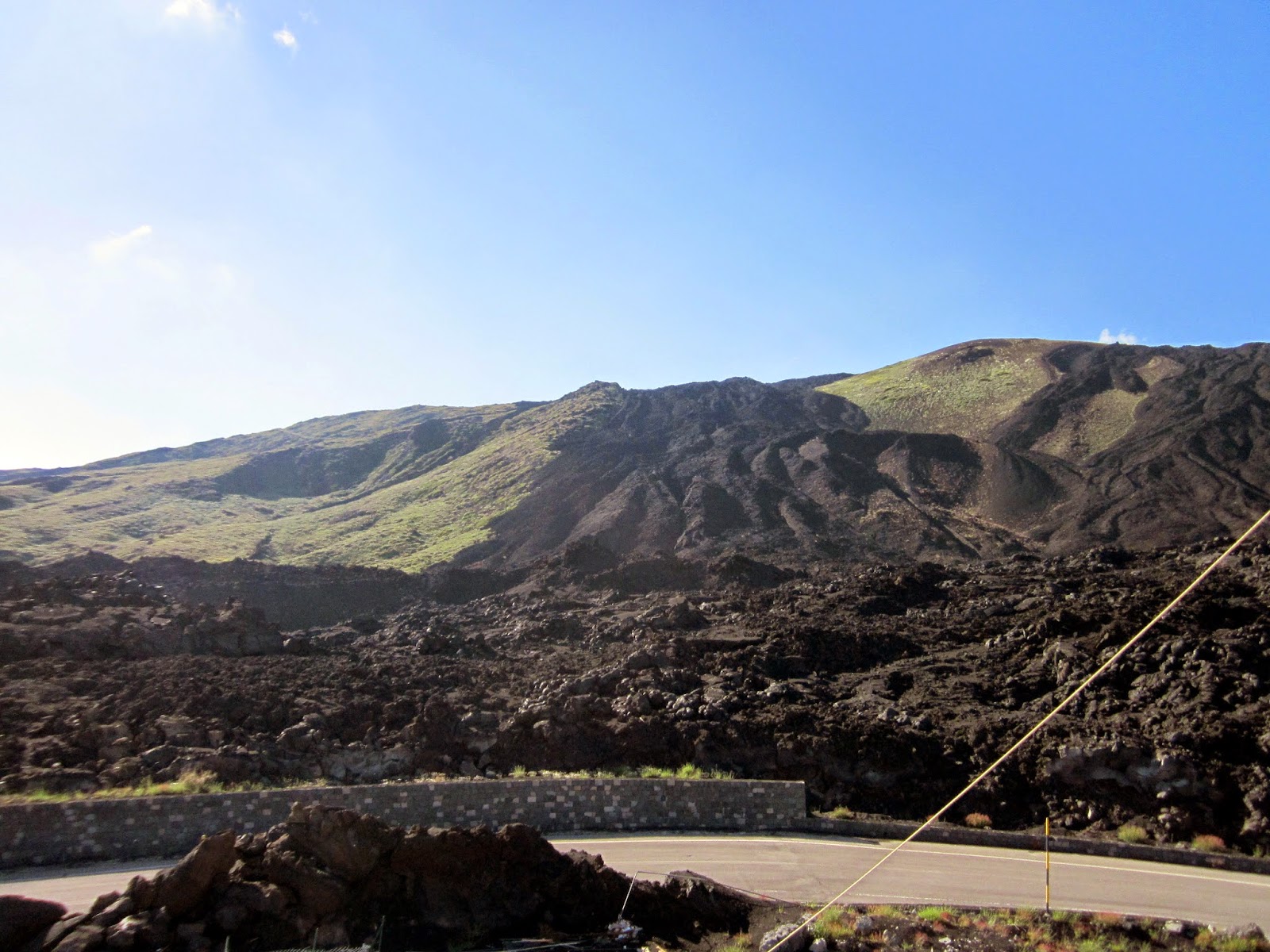
While in Sicily, I was shocked to discover how weak I still was. DM damages the proximal muscles in the legs, including the hips and buttocks. Not only did I have difficulty with stairs, but my legs would frequently go out from under me on steep steps. I would take a step and suddenly find myself collapsed on my haunches. That was a real problem when boarding and disembarking tourist buses. When I tried to board the funivia to Mt. Etna, my legs once again gave out on me. I lurched forward and hit my head on the pole in the middle of the car as the funvia continued on, heedless of my downward trajectory. On the way back, I collapsed again, and as we pulled away, we saw a guy talking into a walkie-talkie. When we reached the bottom, the car stopped to let me off. The man had obviously been calling ahead to warn the people down below. Indeed, I fell so many times on Etna Keith that joked, "We're banned for life."

Acting as a human weather sock on Etna. It was extremely windy up there.


Even so, without the increased prednisone dose, we might not have been able to walk up the steep hills to all those wonderful ancient ruins we loved so much. There were still places that I couldn't go, but I was able to do far more than I thought I could.


While we were staying on Etna, I developed my first symptoms of listeriosis, almost certainly caught by unpasteurized cheese I had unwittingly eaten. That should've been a warning sign, but I had never been told to watch out for immunosuppression-related illnesses.

The view from our balcony on Etna
When you read about Legionaires' disease, the first thing they often mention is that immunosuppressed travelers are among the most at risk. When I was first put on prednisone, I looked up the side effects. Among the long list--many of which I've since experienced--was a compromised immune system. But no one warned me to watch out for symptoms that would've been minor before I started my treatment.

So, when I developed a hacking cough in the waning days of our vacation, we thought nothing of it. Mussolini's Revenge, we joked. But a few days after we returned home we learned that it wasn't such a laughing matter. After I had spent all day in bed, Joella realized something was wrong and she called Keith. He rushed home from work and found me still lying in bed, unable to dress myself. When he asked me why I hadn't turned on the air conditioner, I said, "I like the heat." It was 105 that day, and I hate the heat.

Keith dressed me and rushed me to the hospital. It was there that I went into septic shock, which made my blood pressure plummet, causing extensive watershed-area stroke damage in my brain and putting me into a deep coma. Watershed damage tends to occur in the less vital areas of the brain and it frequently bounces back better than other types of damage. That's why my "profound brain damage" caused so few serious effects.

Six weeks later, when I awoke from the coma, I discovered that my dermatomyositis had gone into remission.

Flash forward several months. I was close to finishing stepping down from the prednisone when I starting experiencing severe withdrawal symptoms. We were returning from a rehab walk at the Los Angeles County Arboretum when I suddenly puked up the lunch I had eaten at the Peacock Cafe. These severe episodes continued until my rheumatologist slowed down my step-down schedule. I'm finally at that end-point again, this time without any withdrawal symptoms.

The list of all the side-effects the prednisone caused me would fill several blog posts. Some of them, like my osteoporosis, are serious and lasting, but as of tomorrow, I will be able to wave bye-bye to prednisone.

Good riddance to bad (but necessary) medications!

Contact me!

Name

Email *

Message *

Coma Girl

Coma Girl

Not a miracle recovery, but a miracle of modern medicine

In 2013 I fell into a six-week coma and nearly died after I contracted legionella. The Legionnaire's disease was in turn triggered by immunosuppression caused by the prednisone I was taking for my rare autoimmune disease, dermatomyositis.

I suffered a series of strokes on both sides of my brain when the sepsis caused my blood pressure to plummet. I fell into a deep coma. My kidneys and lungs began to fail, as my body was began dying one organ at a time. My doctors told my loved ones to give up hope for my full recovery. They expected me to die, and even if I somehow lived, I would remain a vegetable or at best left so hopelessly brain-damaged that I would never be same. But unbeknownst to them, while they were shining lights in my eyes and shaking their heads, I was telling them in my coma-dream--my secular version of a near-death experience--to leave me alone because I was trying to get back to sleep. I was experiencing what is known as covert cognition, the subject of my Skeptical Inquirer article "Covert Cognition: My So-Called Near-Death Experience," which appeared in their July/August issue.

But it wasn't a miracle--despite what so many continue to believe--that I recovered so fully. I owe my life not to God, but the miracles of modern medicine, as well as the nature of the watershed-area brain damage I suffered, as I detailed in my article and in this blog.